You can practise IELTS Speaking alone by recording yourself answering real questions under the real timings: short Part 1 answers, one minute of notes and two minutes of speaking for Part 2, and longer Part 3 answers. Then listen back with the band descriptors beside you. AI feedback is useful for what can be measured, such as length, pace, hesitation and grammar slips; pronunciation and natural vocabulary still need a careful ear.
3
parts to practise, not just the long turn
1 + 2
minutes to prepare and to speak in Part 2
4
passes over each recording, one per criterion
30
minutes for one complete practice session
Can you really prepare for IELTS Speaking on your own?
Mostly, yes. Three of the four things the examiner rates (how easily you keep going, the words you choose and the grammar you produce) show up clearly in a recording, and the fourth, pronunciation, can be checked by listening as a stranger would. What a recording cannot give you is an examiner's reaction, or the surprise of a question you did not expect.
So the two rules of practising alone are to keep the conditions honest and to keep the questions new. A recording made with notes in front of you, or of a question you have answered twenty times, tells you about your memory, not your speaking.
It also helps to know what you are practising for. IELTS is now delivered on computer, after the March 2026 announcement that the paper test would end, but the Speaking test is still taken face to face with a human examiner, and it is still recorded. The three parts, their timings and the four criteria are unchanged.
How do you set up a practice session?
You need a phone or laptop that records, a timer, and questions you have not prepared. Then run the parts in order, without stopping the recording, the way the examiner would:
To scale
A 30-minute practice session on your own
- Part 1 questions · 5 minFour or five questions, answered without pausing the recording
- Part 2 card · 4 minOne minute of notes, then up to two minutes, timed
- Part 3 questions · 5 minThree or four longer questions on the card's theme
- Listen and note · 11 minFour passes: fluency, vocabulary, grammar, pronunciation
- Record again · 5 minThe two answers that went worst, once each
Choose new questions before you start
Pick a Part 1 topic, a cue card and a Part 3 theme you have not practised. Choosing in advance stops you picking the easy ones.
Hear the question rather than read it
In the test the examiner asks every question aloud, apart from the Part 2 card, which you also read. Hearing it first, as below, trains you to understand spoken questions and to answer without seeing them.
Keep the real timings
Part 1 answers of about 15 to 30 seconds. For Part 2, one minute of notes, then talk until two minutes are up. Part 3 answers of up to a minute, with a reason and an example in each.
Do not stop the recording
Hesitations, restarts and mistakes are the information you need. A recording you paused and tidied tells you nothing about your fluency.
Start with these three, one from each part. Each plays in the examiner's voice and lets you record an answer and play it back; the Part 1 and Part 3 ones have a Band 8 sample to compare with afterwards.
What is the first thing you do after you wake up?
Sample answerBand 8AnswerReasonDetail
- Answer
- Reason
- Detail
Honestly, the very first thing is reaching for my phone, which I know is a terrible habit. It's the only thing that really drags me out of that half-asleep state. Once I'm properly awake, I open the curtains and drink a big glass of water before I even think about coffee.
- a terrible habit
- something you do often but shouldn't
- drags me out of
- pulls me, with effort, out of a state
- before I even think about
- before I consider doing something else
51 words · about 22 seconds spoken
Describe a gift you received that you liked.
Do you think people depend too much on technology today?
Sample answerBand 8My viewWhyExampleBut
- My view
- Why
- Example
- But
In certain respects we do, especially when it comes to basic skills we've stopped bothering to learn. If a device does something for us, our own ability tends to wither, and we don't notice until the device fails. Plenty of people can't find their way across their own city without satellite navigation, or remember a single phone number apart from their own. On the other hand, depending on tools is hardly new. We rely on cars and calculators without anyone calling it a problem, so the real question is whether we're losing skills that actually matter.
- when it comes to
- on the subject of
- tends to wither
- gradually becomes weaker
- hardly new
- not new at all
96 words · about 42 seconds spoken
How do you check a recording against the descriptors?
Listen four times, once for each criterion, with a different question in your head each time. Writing the recording down, even roughly, makes the second and third passes far more accurate.
| Pass | What to listen for | What it tells you |
|---|---|---|
| Fluency and Coherence | Pauses to find a word, restarts, the same linker again and again | Whether hesitation breaks the thread (Band 6) or not (Band 7) |
| Lexical Resource | Words used three times or more, general words (good, nice, thing), wrong word partners | Whether your words work or fit |
| Grammar | Every sentence with if, which, when, because or although in it | Whether your complex sentences are mostly right |
| Pronunciation | Any word a stranger would not catch; answers where the rhythm flattens | How much effort you are asking of the listener |
The detail behind each pass, band by band, is in the Speaking band descriptors in plain English. Keep a short log of what each pass found. After a few weeks, the log shows which criterion is actually holding you back, which is more useful than any single score.
How do you practise Part 3 without an examiner?
Part 3 is the hardest part to practise alone, because in the real test the examiner pushes the discussion further with follow-up questions. You can do that for yourself. After each Part 3 answer, before you stop recording, ask yourself one of the questions an examiner might ask next, and answer it:
- Why? Give the reason behind your view, not a second view.
- Can you give an example? One real case: a place, a group of people, something you have seen.
- Is that true everywhere? Compare your country with another, or the city with the countryside.
- Has it always been like that? Compare now with twenty years ago.
- What might happen in future? Speculate, using will, might, is likely to.
Each of those pushes you into a different kind of language: reasons, comparisons, past and present side by side, speculation. A Part 3 answer that only ever states an opinion and stops is a common way to stay at the same band, and asking yourself these questions trains the habit of extending.
A useful shape for each answer is your view, the reason, an example, and the other side: “I'd say…, mainly because… For example,… That said,…”. It keeps an answer to about a minute and shows the range of structures the descriptors look for at Band 7.
What can AI judge well, and what can it not?
AI feedback on speaking is good at measuring and weaker at judging. Use it for what it measures reliably, and treat the rest as a second opinion.
| Reliable | Less reliable |
|---|---|
| How long each answer runs, and whether the long turn reaches two minutes | Pronunciation, which depends on the recording and on the model doing the listening |
| Speaking rate, in words per minute | Whether a word is natural for the topic, not just correct |
| Filled pauses such as um and er, if the transcript keeps them | How well an argument develops across a Part 3 answer |
| Repeated words and phrases | Anything the transcription misheard |
| Grammar errors that appear in the transcript | A band you can rely on as an IELTS result |
The weak point of most AI speaking feedback is the transcript itself. Speech-to-text can mishear accented words, and it can quietly tidy up what you said, removing the hesitations and small errors the descriptors care about. Feedback built on a tidied transcript will be kinder than an examiner.
How does the SpeakMetry Speaking Simulator work?
The Speaking Simulator runs a complete three-part test with an examiner who asks every question aloud. You check in, test your sound and microphone, and then answer hands-free: the microphone opens when she finishes speaking, and your answer ends when you stop talking and pause, as it would in front of a person.
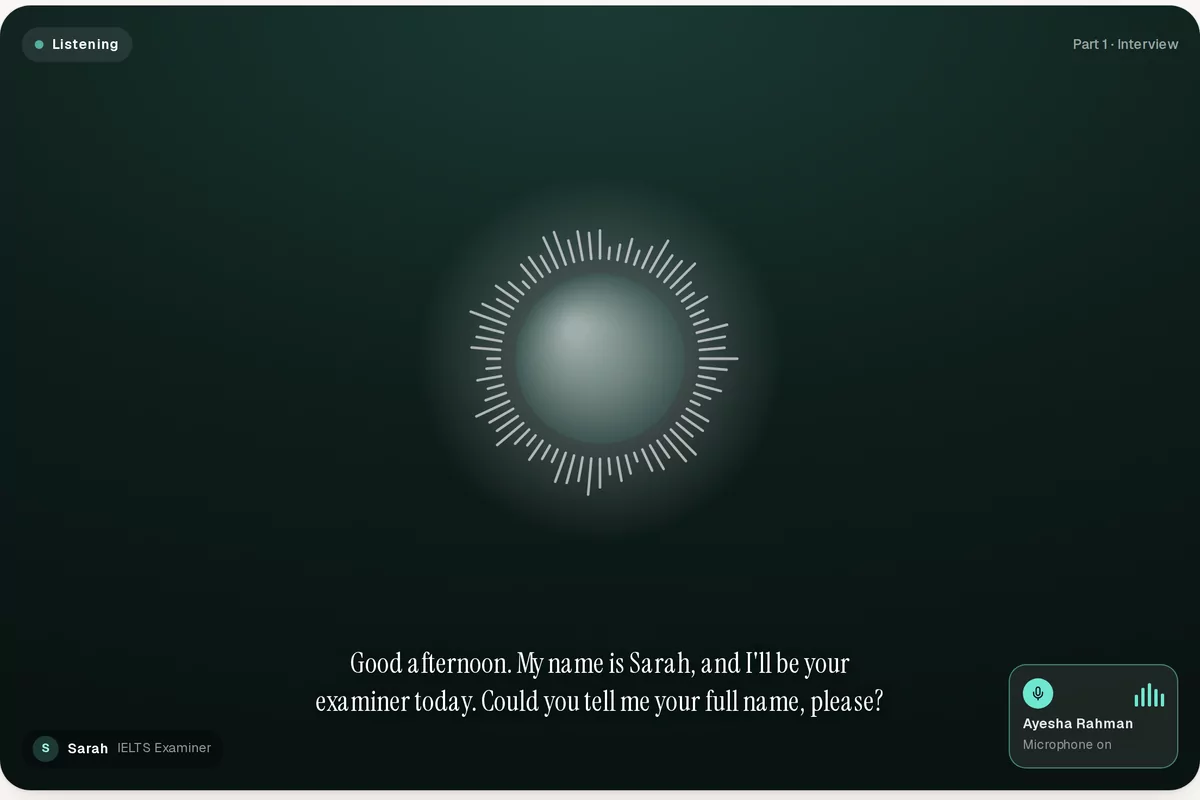
It follows the real test's shape: a Part 1 interview, a Part 2 card with one minute to prepare and a notepad, two minutes to speak, and a Part 3 discussion on the card's theme. In Parts 1 and 3 the examiner can follow up on what you actually said, with a short “Why?” or a question that develops your point.
Afterwards the report gives a band for each of the four criteria, works out the Speaking band from them (their average, rounded down to a half band), and shows which criterion to raise first. It measures how you spoke, answer by answer: length against what each part needs, pace and hesitation. When the long turn is long enough, its recording is used to assess pronunciation from your voice, and every correction is checked against your own words before it is shown, so nothing is quoted that you did not say.
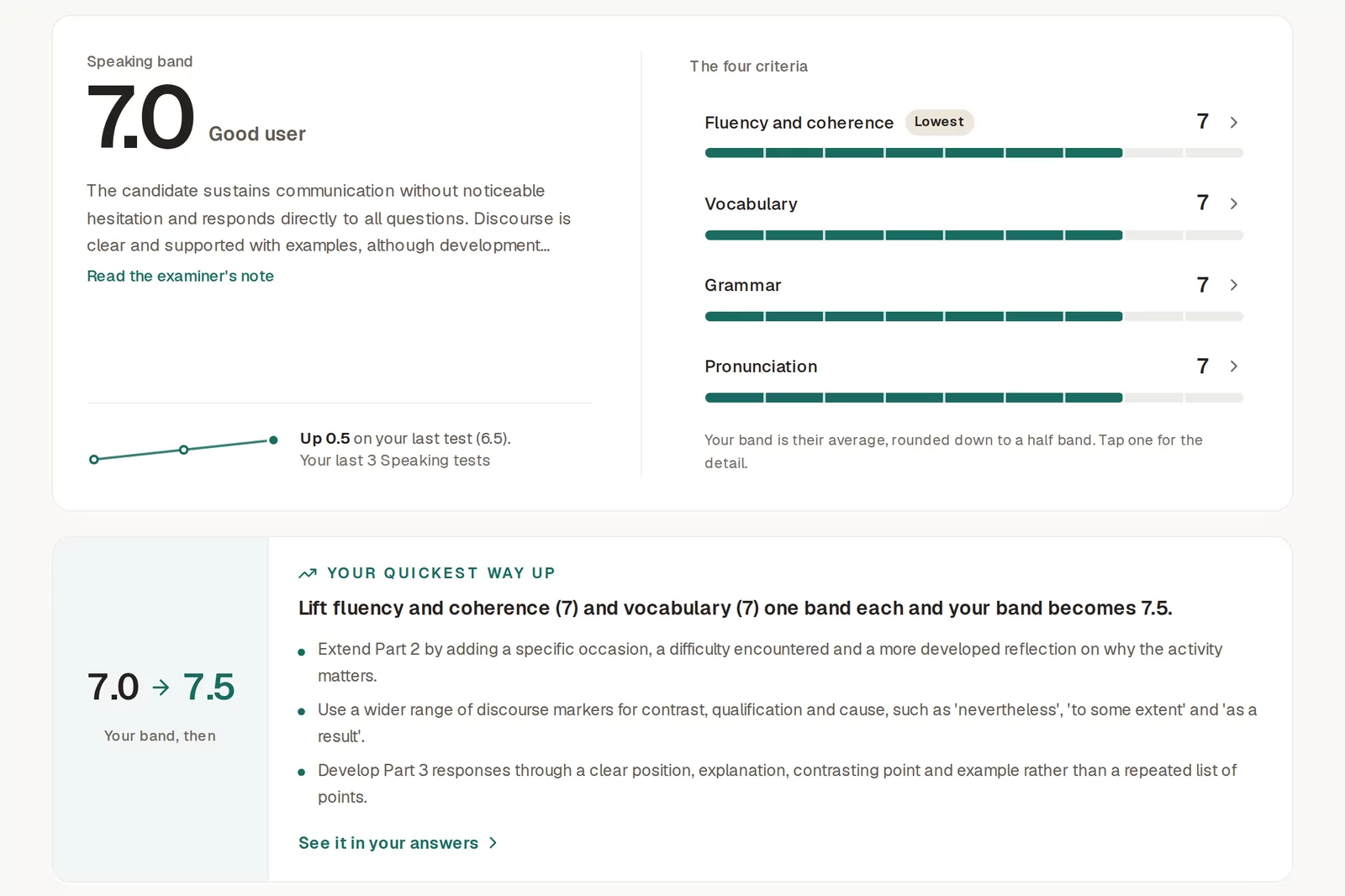
A free account includes one full sitting, with the Speaking band, the examiner's note, the delivery measures and your recordings. The criterion bands, corrections and sample answers are part of a Premium Pass.
Which free tools help when you practise alone?
Three free checkers score a single recorded answer, one for each part: the Part 1 checker, the Part 2 checker and the Part 3 checker. Each asks a real question in the examiner's voice, records your answer, and returns the four criteria with your mistakes marked and an improved version of your own answer. Nothing you record is stored.
For practice without any scoring, the question libraries let you hear and answer as many questions as you like: Part 1 topics, Part 2 cue cards with a preparation timer, and Part 3 discussions. If particular sounds are the problem, the pronunciation checker marks a sentence you read aloud word by word.
What does a week of practice look like?
A routine that mixes one full test with short, focused sessions gives you both a fair picture and steady practice:
Once a week: a full test
All three parts, new questions, recorded in one go. This is the recording you compare from week to week.
Two or three times a week: one part, ten minutes
Five Part 1 questions, or two cue cards, or four Part 3 questions. Listen back for the one criterion your log says is weakest.
Once a week: re-record your worst answers
Take the two answers that went worst in the full test and answer the same questions again, once. You are checking whether the fix has started to show, not rehearsing.
Every day, if you can: five minutes of speaking
Describe what you did yesterday, or answer one question aloud on the way somewhere. Fluency grows with time spent speaking, not only with time spent studying.
What should you avoid when you practise alone?
Most of the habits that waste solo practice come from trying to make the recording sound good, rather than making it honest:
Said, and better
Practice habits, and what works better
Writing answers out and reading them aloudSpeaking from three or four keywords, never a script
The test has no script. Reading aloud practises reading; speaking from keywords practises what the examiner actually hears.
Pausing the recording to think, then starting againOne take, mistakes and all, then listening back
In the test you cannot stop. A recording with your real hesitations in it is the only one that tells you about your fluency.
Recording the same answer until it is perfectRecording it twice at most, then moving to a new question
The tenth take is a rehearsed speech. What you need is the ability to answer a question you have not seen.
Practising only Part 2Running all three parts, at least once a week
The descriptors rate your average across the whole test, and Part 3 asks for longer, developed answers. You only find out whether yours develop by practising it.
Trusting a single score from an appWatching the same measures over several recordings
Any automatic score is an estimate. A trend across five recordings, in measures like length and hesitation, tells you far more than one number.
Try it on a full paper
Speaking · 11 to 14 minutes
A band for each criterion, corrections and sample answers.
The Speaking Simulator is the closest you can come to the real test at home, with an examiner who asks, listens and follows up, and a report on the four criteria. For a single question at a time, the Part 1, Part 2 and Part 3 checkers score one recorded answer, and the guide to Band 7 shows what to listen for in your own recordings.
Where to check this
Every rule in this guide comes from these official pages. Test centres can differ on dates and arrangements, so check yours too.
- IELTS Academic Speaking test format · IELTS
- IELTS Speaking band descriptors · IELTS
- Updates to IELTS test delivery · IELTS
- Computer-delivered IELTS · IDP
- 7 mistakes to avoid in the IELTS Speaking test · IDP IELTS
Questions people ask next
Can you improve at IELTS Speaking without a teacher or partner?
Yes, for most of what the examiner listens for. Recording yourself under real timings and checking the recording against the band descriptors shows you your hesitations, repeated words, grammar slips and unclear words. What you cannot fully practise alone is being asked something unexpected, which is why questions you have not seen before matter.
How accurate are AI scores for IELTS Speaking?
They are estimates, not IELTS results. AI is reliable at measuring things such as answer length, pace, hesitation and errors that appear in a transcript. It is less reliable at pronunciation and at judging whether vocabulary is natural, and speech-to-text can mishear or quietly tidy up what you said. Use it to track trends, not as a promise of a band.
Should I practise IELTS Speaking with written answers?
No. Writing answers and reading them aloud practises reading, and memorised answers tend not to fit the exact question. IDP's advice is that memorised responses do not flow conversationally. Practise speaking from keywords, so that the words are produced on the spot, as they will be in the test.
Is the IELTS Speaking test done on a computer now?
No. Listening, Reading and Writing are now taken on computer, but the Speaking test is still face to face with a human examiner in a quiet room, and it is still recorded. Practising with a computer is useful all the same, as long as the questions, timings and pressure are close to the real thing.
How often should I record a full Speaking test?
Often enough to compare like with like. A full three-part recording once a week, with shorter practice on single parts in between, gives you recordings far enough apart to show change. Recording the same answers every day mostly shows you how well you have memorised them.
Written by SpeakMetry Team
The team that builds SpeakMetry's mock tests writes these guides. Every rule is checked against the official IELTS, British Council and IDP pages listed in the guide, and every example question, passage and sample answer was written for the guide it appears in.