Part 2 cue cardChildhood and memories
Describe a toy you enjoyed playing with as a child
Most answers describe the toy and the giver, then stall. The marks sit in "how you played with it": a past routine told with used to and would, with one scene that makes the play real.
- 1 minute to prepare
- Up to 2 minutes
- Samples at Band 6, 7 and 8
- Updated 20 October 2026
The cue card
Describe a toy you enjoyed playing with as a child.
You should say:
- what the toy was
- who gave it to you
- how you played with it
- and explain why you liked it so much
Rehearse the long turn
1 minute to prepare · 2 minutes to speak
A 60-second plan
- what the toy waswire car, flip-flop wheels, red paint
- who gave it to youcousin Otieno made it, 7th birthday
- how you played with itsteering pole, races down church hill
- and explain why you liked it so muchmade for me; learned to fix things
Sample answers
Band 6 sample answer
224 words · about 1:57 spoken at a Band 6 pace
Well, the toy I want to describe is a wire car. Maybe it sounds strange, but in Kenya, where I grew up, many children play with this kind of cars. It is made from old wire, like from coat hangers, and the wheels are made from rubber from old slippers. It has a long stick so you can push it and steer it while you are walking behind.
My cousin Otieno made it for me when I turned seven. He was fourteen at that time and he was very good with his hands. I remember he spend almost one week to make it, and he even painted the body with red colour.
How I played with it? Every day after school I used to push it along the road to my friend's house, and we made races down the hill behind the church. If a wheel fell off, I fix it myself with my father's pliers. Sometimes I put mangoes on the back and pretended I was a lorry driver who was delivering fruit to the market.
I liked it so much because it was made only for me, not bought in a shop. All the boys in our street was jealous. Also, I think this toy is the reason why I am interested for engineering now, because it taught me how things work.
The mistakes that keep it at Band 6
- this kind of cars should be this kind of car
- he spend almost one week to make it should be he spent almost a week making it
- painted the body with red colour should be painted the body red
- How I played with it? should be How did I play with it?
- we made races should be we had races
- I fix it myself should be I fixed it myself
- All the boys in our street was jealous should be All the boys in our street were jealous
- interested for engineering should be interested in engineering
Why this is Band 6, not Band 7
- Fluency and coherence
- Willing to keep going and answers all four bullets in order, even signposting the third with a question to itself ("How I played with it?"). It stays at Band 6 because the linking is basic ("Also", "because", "and"), so the story is a run of facts rather than a narrative that builds.
- Vocabulary
- Enough words to describe an unusual toy clearly ("coat hangers", "pliers", "lorry driver"), and the meaning always comes across. But some choices are awkward: "painted the body with red colour" and "we made races" are not natural collocations, and Band 7 would add less common, precise items.
- Grammar
- Tries complex structures, a relative clause and a conditional among them, but the errors appear exactly there: "If a wheel fell off, I fix it" mixes tenses, "he spend almost one week to make it" misses the past, and "was jealous" doesn't agree with its plural subject.
Pronunciation is the fourth criterion; it is judged from your voice, so a written sample cannot show it.
Band 7 sample answer
246 words · about 1:54 spoken at a Band 7 pace
The toy that really stands out from my childhood is a wire car, which is something you'll see a lot of in western Kenya, where I grew up. It's basically a model pickup truck made out of bent coat-hanger wire, with wheels cut from old rubber flip-flops and a long steering pole that reaches up to your hand, so you can walk behind it and turn the front wheels.
It was a present from my cousin Otieno for my seventh birthday. He was fourteen and already the person everyone on our street went to when a radio or a bicycle broke, so I suppose it was natural that he'd make something rather than buy it. He even painted it bright red.
I used to take it everywhere. I'd steer it all the way to school in the morning, and in the evenings a few of us would race our cars down the slope behind the church, which usually ended with somebody's wheel flying off into the bushes. I'd also load it with mangoes from our tree and pretend I was delivering them to the market.
As for why I loved it so much, I think it's because it was one of a kind. Nobody else had a car quite like mine, and because it kept falling apart, I had to learn how to fix it with my dad's pliers. Looking back, that's probably where my interest for engineering came from, which is what I'm studying now.
The slips
- interest for engineering should be interest in engineering
Why this is Band 7, not Band 8
- Fluency and coherence
- Speaks at length with no sign of effort and links the bullets smoothly ("As for why I loved it so much", "Looking back"). Not Band 8 because the shape is predictable: each paragraph opens with a signpost for the next bullet, rather than the story carrying itself.
- Vocabulary
- Some less common, well-chosen items ("one of a kind", "steering pole", "kept falling apart") make the toy easy to picture. Band 8 would be precise throughout; "a lot of" and "really stands out" are safe, familiar choices.
- Grammar
- A good range used mostly accurately: "I'd steer it" and "would race our cars" for past habits, relative clauses, a clause of reason inside a longer sentence. One slip, "interest for engineering", where the preposition is wrong.
Pronunciation is the fourth criterion; it is judged from your voice, so a written sample cannot show it.
Band 8 sample answer
276 words · about 1:54 spoken at a Band 8 pace
If I think back to the toys I had, the one I was genuinely attached to was a wire car. They're a bit of a tradition in Kisumu, where I grew up: you take a few coat hangers, bend them into the frame of a lorry or a pickup, cut wheels out of a worn-out flip-flop, and attach a long steering column so you can guide it along as you walk.
Mine was handmade by my cousin Otieno, who was fourteen at the time and something of a neighbourhood mechanic. He gave it to me, painted bright red, on my seventh birthday, and I later found out he'd spent the best part of a week on it, straightening the wire with a stone because he didn't own any proper tools.
I played with it pretty much non-stop for about three years. On the way to school I'd steer it round the potholes as if I were a matatu driver, and after school there'd be races down the hill behind the church, with half the street cheering and arguing about who'd won. When it lost a wheel, which happened constantly, I'd sit on the doorstep and patch it up with my father's pliers.
What made it so special, I think, was that it had been made specifically for me, and that set it apart from anything you could pick up in a shop. But it also taught me something without my noticing: that if a thing breaks, you can take it apart and work out why. I'm now in my second year of mechanical engineering, and I'm fairly sure that little red car is where it started.
Why this is Band 8, not Band 9
- Fluency and coherence
- Effortless and fully connected: each bullet gets a scene, and the ending ties the toy to the speaker's present ("that little red car is where it started"). Short of Band 9 only because a few links ("I think", "But it also") are conventional rather than varied.
- Vocabulary
- Wide and precise, with natural idiom: "genuinely attached to", "the best part of a week", "something of a neighbourhood mechanic", "patch it up". Band 9 would keep that precision in every stretch, not mostly in the second and third paragraphs.
- Grammar
- A wide range handled accurately: past perfect for what came before ("he'd spent"), a passive past perfect ("had been made specifically for me"), "as if I were" for an imagined comparison, and habits with "I'd". No errors; Band 9 would use such structures with even more flexibility.
Pronunciation is the fourth criterion; it is judged from your voice, so a written sample cannot show it.
Rounding-off questions
- Are children's toys today better than in the past?
- Better made, certainly, and some are genuinely educational. But a lot of them do everything for the child, whereas a wire car or a ball made of plastic bags left plenty of room for imagination.
- Do toys help children learn?
- I think they do, though not always in the way the box claims. Building blocks, or a toy you have to repair, teach patience and problem-solving far better than a gadget that just reacts to a button.
Phrases worth reusing
one of a kind
unique; there is nothing else quite like it
kept falling apart
broke into pieces again and again
genuinely attached to
truly fond of something, emotionally
the best part of a week
most of a week; nearly seven days
something of a neighbourhood mechanic
to some degree known locally as a mechanic
patch it up
repair something quickly, often not perfectly
set it apart from
made it different from, and better than, others
without my noticing
without me being aware of it happening
If the obvious answer doesn't fit
- A board or card game the whole family played together
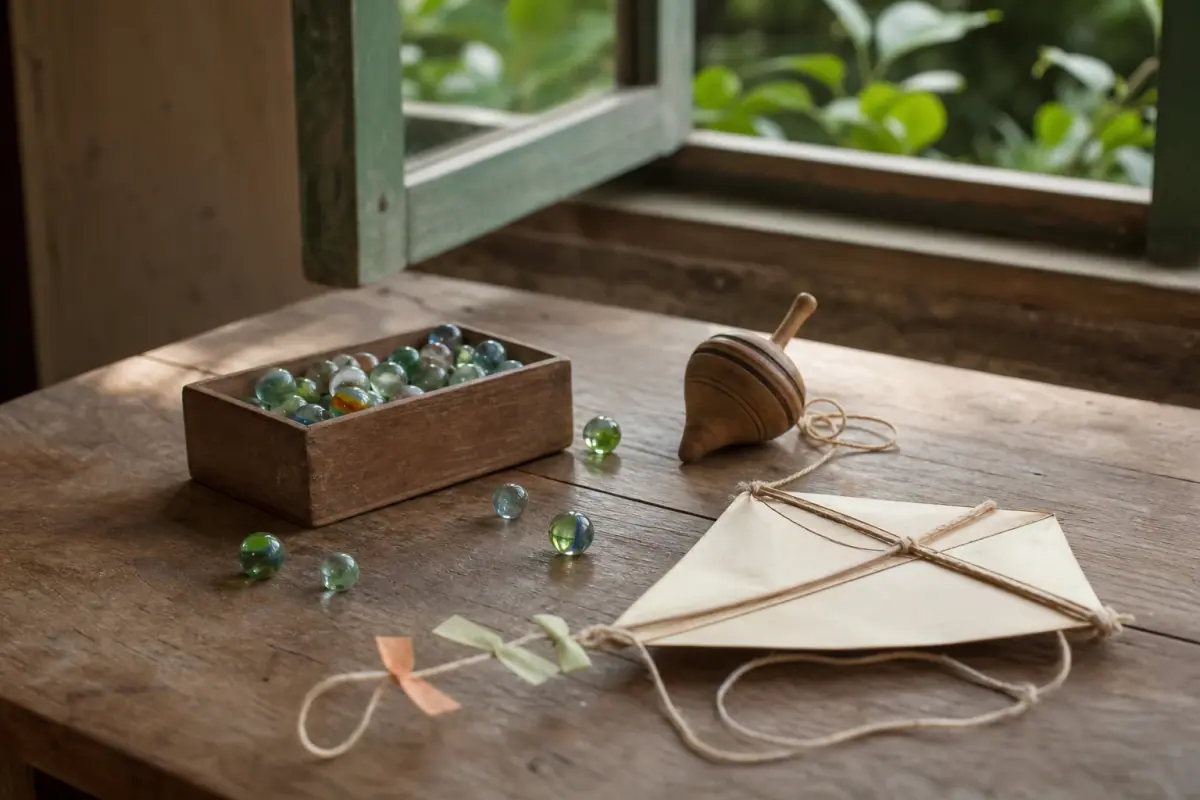
- Something you made yourself from household objects, like a kite
- A toy you wanted badly but never had, and what you played with instead